Weaving Artistry on Grass: Exploring the Delicate World of Lawn Embroidery
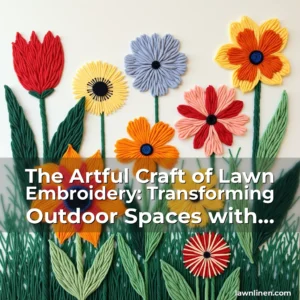
Lawn embroidery, an exquisite blend of traditional needlecraft and botanical artistry, transforms ordinary lawns into breathtaking canvases of creativity. This practice involves weaving intricate designs directly into grass using specially crafted threads, creating a seamless fusion of nature and human ingenuity. As awareness grows about sustainable living and decorative innovation, lawn embroidery has emerged as a captivating hobby for both seasoned artisans and curious beginners.
The allure of lawn embroidery lies in its ability to turn vast expanses of green space into personalized works of art. Unlike conventional embroidery confined to fabric, this technique embraces the unpredictability of natural terrain, inviting practitioners to harmonize patterned precision with the wild beauty of grass. Whether adorning private gardens or public parks, these embroidered landscapes offer a unique way to celebrate both craftsmanship and ecology.
Understanding the Essence of Lawn Embroidery
Lawn embroidery is not merely a variation of traditional needlework—it is a distinct discipline requiring specialized knowledge and adaptive techniques. At its core, the process involves embedding colored threads into the surface of grass to form patterns, symbols, or pictorial scenes. The challenge lies in working with the natural variability of grass blades, which differ in length, density, and texture depending on the environment.
This art form demands careful consideration of materials and methods. Traditional embroidery threads, often made of silk or cotton, must be replaced with sturdier alternatives designed to withstand outdoor conditions. Additionally, practitioners must develop a keen sensitivity to the tactile qualities of turf, learning to manipulate threads without damaging the underlying vegetation or compromising its vitality.
- Durable Threads: Specialized synthetic or UV-treated threads are essential for resisting sunlight degradation and preventing fraying over time.
- Terrain Adaptability: Designs must account for variations in ground slope, moisture levels, and foot traffic to ensure long-term stability.
- Eco-Friendly Practices: Many artists prioritize biodegradable materials and low-impact dyes to minimize environmental disruption.
Mastering lawn embroidery requires patience and experimentation. Artists frequently test new techniques on smaller patches before undertaking larger installations, adjusting tension, thread thickness, and stitch placement to achieve optimal results. The goal is always to create visually striking compositions that enhance—not overshadow—the natural landscape.
Beyond aesthetics, lawn embroidery carries practical implications. In urban settings, these embroidered spaces serve as sensory sanctuaries, offering moments of calm amid concrete surroundings. For rural properties, they can act as markers for trails, guiding visitors through carefully curated paths woven with floral motifs or geometric patterns.
Historical Roots and Evolution of Lawn Embroidery
The history of lawn embroidery traces back centuries, though its modern iteration has evolved significantly from earlier forms. Ancient civilizations experimented with ornamental ground coverings, but true lawn embroidery as we know it began gaining prominence during the Renaissance period. Wealthy landowners commissioned elaborate tapestries stitched directly into meadows, using dyed grasses and imported silks to create stunning displays of status and refinement.
As industrialization progressed in the 19th century, the availability of mass-produced textiles influenced the development of lawn embroidery. Gardeners and textile artists collaborated to refine techniques, incorporating machine-made threads into hand-stitched designs. This era saw the rise of dedicated embroidery guilds focused on preserving the art form’s integrity while adapting it to changing times.
From Royal Gardens to Modern Innovations
In the 18th and 19th centuries, European royalty pioneered the integration of embroidery into landscaped grounds. Notable examples include Versailles’ famed embroidered walkways, where gold-threaded monograms formed intricate borders along palace approaches. These early experiments laid the groundwork for future generations seeking to merge functionality with artistic flair.
Today’s lawn embroiderers draw inspiration from both historical traditions and contemporary trends. Digital technologies now allow for precise stencil-based designs, enabling complex patterns previously unimaginable with manual stitching alone. Moreover, environmental consciousness has driven innovations in non-invasive methods, such as laser-cutting artificial turf with embedded metallic filaments to simulate embroidered effects without disturbing native ecosystems.
Despite technological advancements, many purists still favor traditional hand-stitching methods passed down through generations. Workshops teaching heritage techniques continue to thrive, attracting enthusiasts eager to preserve the authenticity of this ancient craft.
Materials and Techniques Used in Lawn Embroidery
Selecting appropriate materials is crucial for successful lawn embroidery. While standard embroidery floss provides vibrant hues, it lacks the resilience necessary for outdoor use. Instead, artisans opt for high-quality polyester or polypropylene threads infused with UV stabilizers to prevent fading and deterioration caused by prolonged sun exposure.
A wide range of needles designed specifically for grass weaving ensures precise control without damaging fragile shoots. Some specialized tools feature curved tips ideal for navigating dense foliage, while others incorporate micro-cam mechanisms to adjust pressure dynamically during stitching operations. Complementing these instruments are custom-designed frames that stabilize grass surfaces, allowing even distribution of tension across entire projects.
Technique-wise, several foundational methods guide effective lawn embroidery execution. Loop stitching creates raised dimensional effects mimicking blooming flowers, whereas backstitching produces clean lines suitable for geometric compositions. French knots add textured depth perfect for rendering leaves or petals, and whipstitches bind disparate sections together seamlessly.
Each method serves unique purposes based on desired visual impact. For instance, satin stitches produce smooth gradients useful for shading skies or water reflections, while cross-hatching adds structural definition to architectural features like bridges or gazebos integrated within embroidered landscapes.
Design Principles for Effective Lawn Embroidery
Crafting compelling designs begins with thoughtful planning rooted in fundamental principles of visual composition. Color theory plays a vital role, dictating how various shades interact against natural backgrounds. Warm tones tend to recede into distance, making them excellent choices for distant accents, while cool blues and greens appear closer, ideal for foreground detailing.
Symmetry offers structured elegance particularly appealing in formal gardens or memorial sites where order conveys reverence. However, asymmetrical layouts introduce dynamic energy better suited for recreational areas aiming to stimulate engagement through unexpected discoveries as viewers traverse embroidered paths.
Scale presents another critical factor influencing overall effectiveness. Larger-than-life embellishments overwhelm delicate grasses, risking damage from heavy thread loads. Conversely, excessively tiny patterns become indistinct, losing their intended visual punch. Finding equilibrium means considering both immediate visibility and long-term durability simultaneously.
Layering introduces dimensionality absent from flat renderings. By superimposing translucent overlays featuring lighter tints atop darker base layers, embroderers simulate atmospheric perspective akin to painted landscapes. This technique enriches spatial perception, drawing observers deeper into immersive experiences created purely through textile manipulation.
Balancing Aesthetics and Functionality
Anchored firmly within practical constraints, lawn embroidery necessitates judicious balancing acts between beauty and utility. Footpaths require reinforcement beyond mere decoration, employing heavier gauge threads interwoven with geotextile netting to prevent erosion caused by repeated passage. Drainage channels must remain unobstructed beneath embroidered layers, ensuring groundwater flow remains unaffected despite added topographical complexities.
Seasonal fluctuations further complicate matters, demanding anticipation of annual cycles. Springtime thawing loosens compacted soils, potentially dislodging lower-level stitches. Summer heat intensifies wear on exposed fibers, requiring periodic restorative treatments. Autumn frosts pose additional risks, contracting materials unevenly across varying elevations within embroidered zones.
To mitigate these challenges, experts recommend implementing modular frameworks allowing easy reconfiguration according to shifting environmental conditions. Sectional units fastened via adjustable connectors enable removal and replacement of damaged portions without compromising adjacent segments—a pragmatic solution aligning artistry with real-world pragmatism.
Moreover, accessibility concerns demand attention in public installations. Ramps incorporated into embroidered walkways accommodate wheelchair users, while contrasting color schemes aid those with visual impairments distinguishing navigational routes from decorative elements. Thoughtful inclusion of such considerations transforms lawn embroidery from singular artistic endeavors into inclusive community assets.
Applications Beyond Decorative Purposes
While initially perceived primarily as ornamental enhancements, lawn embroidery increasingly finds purpose in multifunctional roles. Educational institutions leverage these embroidered landscapes as interactive learning platforms, integrating botany lessons with textile arts instruction. Students analyze ecological relationships by studying how embedded patterns influence pollinator behavior or alter microclimates supporting diverse species.
Healthcare facilities employ embroidered green spaces strategically placed near patient rooms to reduce stress and accelerate recovery rates. Research indicates that viewing regularly maintained embroidered gardens correlates positively with improved mood states and decreased anxiety levels compared to conventional lawns lacking intentional design elements.
Urban planners recognize the potential of lawn embroidery in mitigating heat island effects characteristic of densely built environments. Strategically positioned shaded embroidered areas intercept solar radiation before reaching pavement surfaces, lowering ambient temperatures measurably. Such interventions contribute meaningfully toward climate resilience objectives pursued globally by city governments.
Additionally, cultural preservation initiatives utilize embroidered landscapes to document endangered oral histories and indigenous storytelling traditions. Collaborations between local elders and contemporary artists result in living murals chronicling ancestral narratives woven into grass itself—an evolving testament to enduring legacies preserved through innovative medium.
Challenges Faced by Practitioners
Embarking upon lawn embroidery journeys inevitably entails confronting numerous obstacles testing perseverance and problem-solving acumen. Chief among these difficulties arises from the inherent instability of grass substrates prone to compression underfoot. Repeated pedestrian traffic flattens once-vibrant stitches, diminishing their original visual potency unless fortified appropriately.
Varying humidity levels present another persistent concern. Excessive dampness swells fibers causing distortion, while arid conditions dry out threads leading to brittleness and breakage. Balancing hydration management becomes paramount, necessitating strategic positioning away from irrigation systems or implementation of wick-like structures absorbing excess moisture safely underground.
Pest infiltration constitutes yet another formidable adversary. Moths attracted to synthetic polymers found in commercial-grade threads threaten established compositions by consuming visible strands. Natural deterrents such as neem oil sprays or companion planting arrangements featuring pest-repellent herbs prove instrumental in warding off unwanted intrusions.
Lastly, securing funding support proves challenging for independent creators seeking recognition within broader artistic communities. Grants targeting textile conservation rarely extend explicitly to ephemeral grass-based works, forcing innovators to rely heavily on crowdfunding models or corporate sponsorships to sustain ambitious projects envisioning grander visions than current financial realities permit.
Community Engagement Through Lawn Embroidery
Fostering communal participation lies at the heart of successful lawn embroidery initiatives, transforming solitary pursuits into shared celebrations of creativity. Neighborhood associations organize collective embroidery sessions where residents collaboratively weave stories reflected in recurring motif themes representing shared values or regional folklore. These group endeavors cultivate social bonds while leaving lasting imprints on communal spaces.
Municipalities embrace lawn embroidery as tools for placemaking, commissioning artists to design signature installations defining town identities. Town squares feature embroidered mosaics narrating local histories, while waterfront promenades boast wave-like patterns symbolizing maritime heritages. Such civic engagements elevate grassroots expressions into officially recognized cultural landmarks.
Youth programs capitalize on the versatility of lawn embroidery to engage younger audiences through hands-on workshops merging STEM education with artistic exploration. Participants learn geometric principles through pattern construction, apply mathematical ratios calculating fiber tensions, and study biological processes observing how embedded designs affect soil microbiomes over seasons.
Digital platforms facilitate global connectivity among embroiderers exchanging ideas freely regardless of geographical boundaries. Online forums host virtual exhibitions showcasing international entries, while augmented reality apps overlay digital enhancements onto physical embroidered works, expanding interpretive possibilities through layered storytelling dimensions accessible solely via mobile devices.
Conclusion
Lawn embroidery stands as a remarkable synthesis of artistic vision and ecological mindfulness, proving that beauty and sustainability need not exist in opposition. From its humble beginnings in royal gardens to its present-day evolution embracing cutting-edge technology, this art form continues inspiring innovation across disciplines ranging from architecture to psychology.
Whether you’re drawn to its meditative qualities or captivated by its transformative power reshaping urban landscapes, exploring lawn embroidery opens doors to endless creative exploration. With dedication and imagination, anyone can transform their own backyard—or any verdant expanse—into a living masterpiece celebrating humanity’s enduring relationship with nature.